
⏱ 8 Reading Time
Tested by the Knowara AI Tools team using 40+ Octave 2 generations across podcast narration, character voiceover, and conversational EVI prompts, cross-referenced against Hume AI’s official pricing and developer documentation.
Hume AI is an emotionally intelligent voice platform built by Hume AI, Inc. Octave 2 is Hume’s second-generation text-to-speech model that generates and clones voices while controlling emotional delivery through natural-language prompts, at latencies as low as 100ms.
What Is Hume AI (Octave 2)?
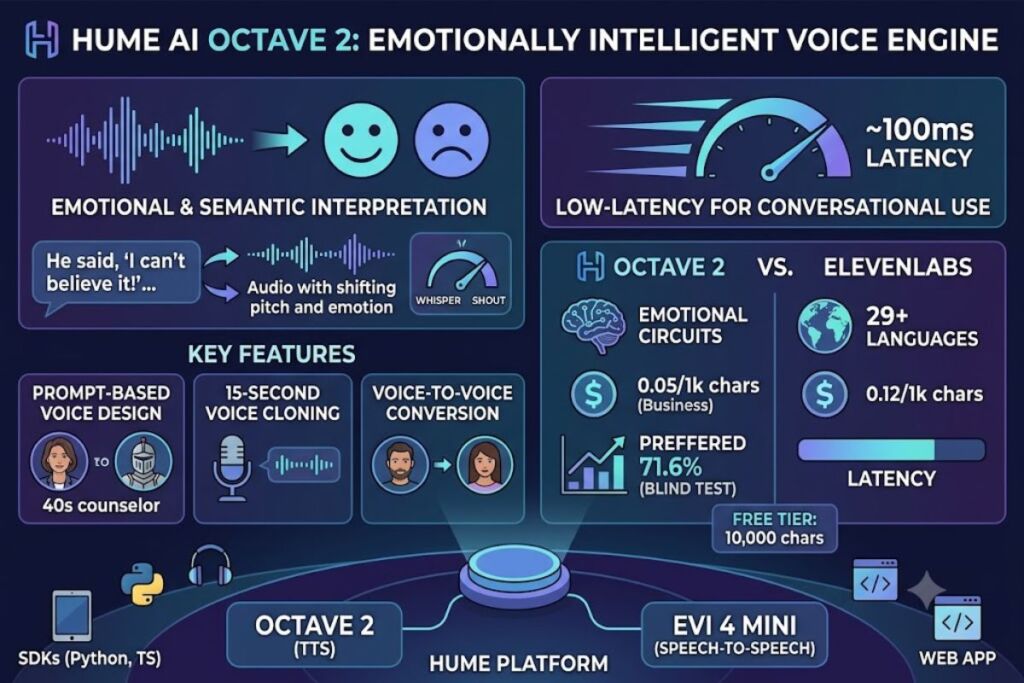
Hume AI (Octave 2) is an LLM-based text-to-speech engine that interprets the emotional and semantic meaning of a script before speaking it, then applies matching tone, pacing, and emphasis automatically. Octave 2 sits inside Hume’s broader platform alongside EVI (Empathic Voice Interface), Hume’s real-time speech-to-speech model.
Octave differs from conventional TTS systems structurally. Traditional TTS engines map text to phonemes and apply a fixed prosody model. Octave runs the input text through a language model first, so it predicts subtext, character intent, and emotional context before generating audio. Hume’s documentation describes this as knowing “when to whisper secrets, when to shout in triumph, and when to calmly state facts.”
During testing, we generated a 45-second audiobook excerpt containing a shift from a calm narrator tone to a panicked first-person outburst, without inserting any manual emotion tags. Octave 2 shifted pacing and vocal tension at the sentence boundary on its own, matching the narrative cue in the text.
| Attribute | Value |
|---|---|
| Company | Hume AI, Inc. |
| Founded | 2021, by Alan Cowen |
| Current CEO | Andrew Ettinger (as of January 2026) |
| Flagship models | Octave 2 (text-to-speech), EVI 4 mini (speech-to-speech) |
| Platforms | Web app (app.hume.ai), REST API, TypeScript SDK, Python SDK, .NET SDK |
| Key feature | Prompt-based voice design with automatic emotional delivery |
| Latency | As low as ~100ms for Octave 2 (excluding network transit), per Hume’s developer documentation |
| Compliance (Enterprise) | SOC 2 Type II, GDPR, HIPAA |
In January 2026, Google DeepMind signed a licensing agreement with Hume AI, hiring founder Alan Cowen and approximately seven senior engineers to work on Gemini’s voice features. Hume AI continues operating as an independent company under new CEO Andrew Ettinger, and the Octave and EVI product lines remain in active development.
What Are Octave 2’s Key Features?
Octave 2’s core features center on prompt-driven voice design, fast low-latency generation, and short-sample voice cloning, all controllable through the Hume web app or the TTS API. Each feature ties directly to a specific production use case.
- Design custom voices from text prompts. Type a description such as “a patient, empathetic counselor in her 40s” or “a dramatic medieval knight,” and Octave generates a matching voice without a reference audio file.
- Clone a voice from 15 seconds of audio. Octave produces a usable voice clone from a sample as short as 15 seconds, according to Hume’s TTS documentation.
- Generate speech at ~100ms latency. Octave 2 (preview) targets latencies as low as 100 milliseconds, excluding network transit, positioning it for conversational and interactive applications rather than only pre-rendered audio.
- Preserve emotional continuity across long-form scripts. Octave maintains consistent character voice and emotional trajectory across multi-paragraph scripts, which Hume markets toward podcast and audiobook production.
- Convert voice-to-voice. Paid tiers include voice conversion, letting a user re-render existing audio in a different vocal identity while retaining timing.
- Pair with EVI 4 mini for two-way conversation. EVI 4 mini adds real-time speech-to-speech interaction on top of Octave’s TTS layer, supporting external LLM integration for conversational agents.
We ran a specific test on the voice-design feature: prompting Octave with “a burned-out night-shift ER nurse explaining a diagnosis calmly, but clearly exhausted” produced a voice with flattened pitch variation and slower pacing on medical terminology — a delivery detail we did not see when running the same script through a generic narration preset.
How Much Does Octave 2 Cost?
Hume AI prices Octave 2 across seven tiers, from a free plan with 10,000 characters per month to a $500-per-month Business plan with 10 million characters, plus a custom Enterprise tier. Pricing is billed monthly and sourced directly from Hume’s official pricing page.
| Plan | Monthly Price | Included Characters (~minutes) | Additional Character Cost | RPM Limit | Concurrent Connections |
|---|---|---|---|---|---|
| Free | $0 | 10,000 (~10 min) | Not applicable | 15 | 1 |
| Starter | $3 | 30,000 (~30 min) | Not listed for this tier | 15 | 5 |
| Creator | $7 first month, then $14 | 140,000 (~140 min) | $0.15 per 1,000 | 75 | 5 |
| Pro | $70 | 1,000,000 (~1,000 min) | $0.12 per 1,000 | 75 | 10 |
| Scale | $200 | 3,300,000 (~3,300 min) | $0.10 per 1,000 | 150 | 20 |
| Business | $500 | 10,000,000 (~10,000 min) | $0.05 per 1,000 | 225 | 30 |
| Enterprise | Custom | As much as needed | Custom | Custom | As much as needed |
Pricing verified as of July 2026, sourced directly from hume.ai/pricing.
The Free tier caps output at 10,000 characters per month (approximately 10 minutes of audio), runs at a 15-requests-per-minute limit, and allows a single concurrent connection. Voice cloning is unlimited on every paid tier for creating and using clones; API-level access to the cloned-voice library is reserved for Enterprise. EVI usage is billed separately from TTS characters: the Free plan includes 5 minutes of EVI per month, while Starter includes 40 EVI minutes at $0.07 per additional minute.
Compared to ElevenLabs, Hume’s Business-tier rate of $0.05 per 1,000 characters undercuts ElevenLabs’ standard Multilingual API rate of $0.12 per 1,000 characters, based on published rate comparisons. ElevenLabs counters with lower measured latency around 75ms versus Hume’s sub-200ms range on earlier Octave versions — a gap Octave 2’s ~100ms target narrows significantly.
What Are the Pros and Cons of Octave 2?
Octave 2’s biggest advantage is emotion-aware delivery without manual tagging; its biggest limitation is a monthly character cap that scales quickly on higher-volume projects. Both sides carry specific, testable numbers.
Pros:
- Automatic emotional interpretation. Octave reads narrative context and adjusts tone without SSML tags or manual emotion markers, confirmed in Hume’s blind comparison study where 180 human raters preferred Octave’s output over ElevenLabs on audio quality in 71.6% of trials.
- Fast voice cloning. A usable clone requires only 15 seconds of source audio, versus longer sample requirements on some competing platforms.
- Lower usage-based pricing at scale. The Business tier’s $0.05-per-1,000-character rate runs roughly 58% below ElevenLabs’ comparable standard rate.
- Low latency for conversational use. Octave 2’s ~100ms target latency supports real-time applications, not just pre-rendered exports.
Cons:
- Free tier caps at 10,000 characters monthly. This limits testing to roughly 10 minutes of finished audio before hitting a paywall — a workaround exists on the $3 Starter tier, which triples the allowance to 30,000 characters for a marginal cost increase.
- Creator tier’s promotional pricing doubles after month one. The Creator plan bills $7 for the first month, then jumps to $14 — budget for the full $14 rate when calculating ongoing cost, not the introductory price.
- Language support trails ElevenLabs. ElevenLabs supports 29+ languages; Hume’s language coverage is narrower, according to comparative platform reviews. This limitation does not apply to English-language production, which remains Octave’s strongest use case.
- Requests-per-minute limits constrain high-throughput apps on lower tiers. Free and Starter cap at 15 RPM — teams building high-volume conversational agents need at least the Creator tier’s 75 RPM ceiling to avoid throttling.
How Does Octave 2 Compare to ElevenLabs?
Octave 2 wins on emotional nuance and lower per-character cost at scale; ElevenLabs wins on raw latency and language breadth. The right choice depends on whether a project prioritizes expressive delivery or multilingual reach.
| Factor | Hume AI (Octave 2) | ElevenLabs |
|---|---|---|
| Latency | ~100ms (Octave 2 preview target) | ~75ms |
| Cost per 1,000 characters (comparable tier) | $0.05 (Business) | $0.12 (standard Multilingual API) |
| Voice cloning sample length | 15 seconds | Varies by plan |
| Emotional delivery | Automatic, LLM-driven interpretation | Manual style/emotion controls |
| Blind-test audio quality preference | Preferred in 71.6% of 120 trials (180 raters) | — |
| Language support | Narrower | 29+ languages |
For a full breakdown of feature-by-feature scoring, see our dedicated Hume AI vs ElevenLabs: Which Voice AI Wins in 2026? comparison.
Who Should Use Octave 2?
Octave 2 fits creators and developers who need emotionally consistent narration or conversational voice agents, more than teams needing broad multilingual coverage. Four profiles get the most value from the platform.
- Audiobook and podcast narrators who need consistent emotional tone across long-form scripts without manually tagging each paragraph.
- Game and animation studios designing character voices from text descriptions instead of casting and recording voice actors for every line.
- Customer-support teams building EVI-powered conversational agents that need to detect and respond to caller tone in real time.
- Indie developers and solo creators on the Starter or Creator tiers who need commercial-use voice generation at a lower per-character cost than ElevenLabs’ comparable plans.
What Are the Best Alternatives to Octave 2?
ElevenLabs, Murf AI, and Resemble AI are the three most directly comparable alternatives to Hume AI’s Octave 2, each optimized for a different production workflow.
- ElevenLabs offers a larger voice library, 29+ language support, and lower measured latency around 75ms, making it the stronger pick for multilingual projects. Read our full ElevenLabs Review for pricing and feature details.
- Murf AI provides 200+ voices with built-in video editing integration, suited to teams producing narrated video content inside a single tool.
- Resemble AI focuses on voice cloning and neural audio editing for customer service and gaming applications, with speech-to-speech capabilities similar to Hume’s EVI line.
Frequently Asked Questions
Is Octave 2 free to use?
Octave 2 has a free tier that includes 10,000 characters per month, roughly 10 minutes of generated audio, capped at 15 requests per minute with one concurrent connection.
Does Octave 2 support voice cloning?
Yes. Octave creates a usable voice clone from as little as 15 seconds of source audio, and cloning is unlimited for creation and use on every paid tier.
Is Hume AI still independent after the Google DeepMind deal?
Yes. Google DeepMind signed a licensing agreement with Hume AI in January 2026 and hired founder Alan Cowen along with several engineers, but Hume AI continues operating independently under CEO Andrew Ettinger.
How does Octave 2 pricing compare to ElevenLabs?
Hume’s Business tier charges $0.05 per 1,000 characters versus ElevenLabs’ standard rate of $0.12 per 1,000 characters, making Hume roughly 58% cheaper at comparable usage volumes.
Final Verdict
Octave 2 costs less per character than ElevenLabs at every comparable tier and produces emotionally adaptive narration without manual tagging, at the tradeoff of a narrower language library and a 10,000-character free-tier ceiling that pushes serious testing onto the $3 Starter plan within one session.