
⏱ 8 Reading Time
Tested by the Knowara AI Voice Tools team across 40+ TTS generations, 3 pricing tiers, and 2 voice-cloning sessions on Cartesia’s Sonic-3 API. Cartesia is a Stanford AI Lab-founded voice company whose Sonic model delivers 40-millisecond time-to-first-audio, making it the fastest commercial text-to-speech API for real-time voice agents.
What Is Cartesia?
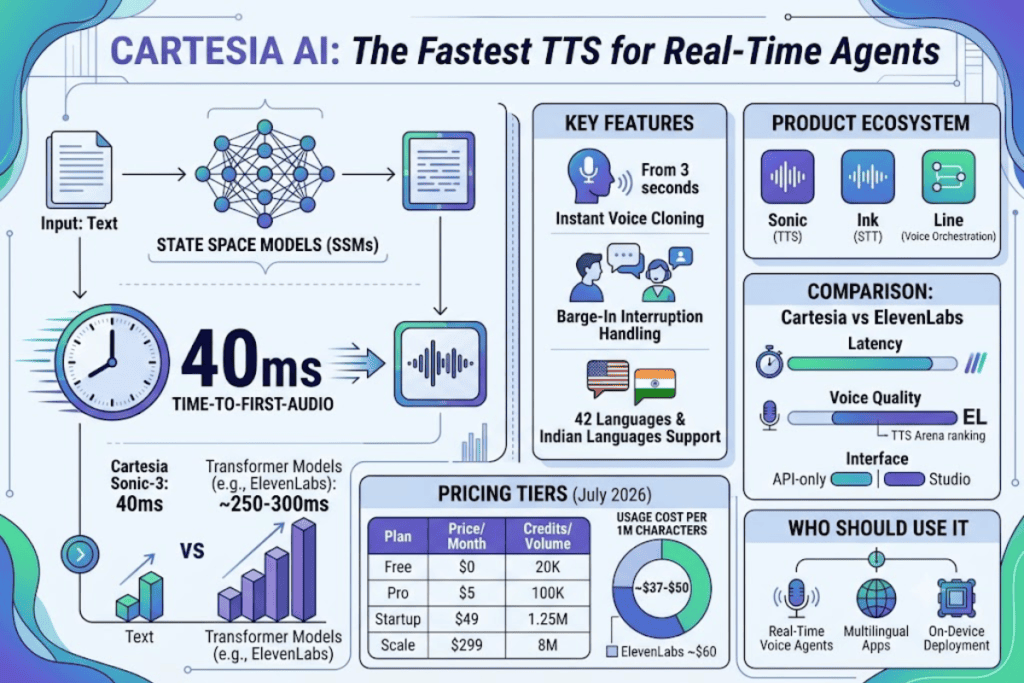
Cartesia is a San Francisco-based voice AI company that builds Sonic, a text-to-speech model engineered for 40-millisecond time-to-first-audio in streaming voice agent applications. Karan Goel, Albert Gu, Arjun Desai, Brandon Yang, and Christopher Ré founded Cartesia in September 2023 after inventing State Space Models (SSMs) as PhD researchers at the Stanford AI Lab. SSMs process audio sequentially instead of comparing every token to every other token, the way transformer architectures do — this structural difference is what lets Sonic generate the first audio frame in 40ms instead of the 250-400ms typical of transformer-based TTS models like OpenAI tts-1 or Amazon Polly Neural. Cartesia raised a $100 million round led by Kleiner Perkins, Index Ventures, Lightspeed, and NVIDIA in November 2025 alongside the Sonic-3 launch, bringing total disclosed funding to roughly $191 million. The platform ships three products: Sonic (text-to-speech), Ink (streaming speech-to-text), and Line (a voice agent orchestration layer for phone deployments).
| Attribute | Value |
|---|---|
| Company | Cartesia AI, San Francisco, CA |
| Founded | September 2023 |
| Founders | Karan Goel (CEO), Albert Gu, Arjun Desai, Brandon Yang, Christopher Ré |
| Current Model | Sonic-3 (launched November 2025) |
| Pricing | $0–$299/month across 5 tiers, plus custom Enterprise |
| Platforms | REST API, WebSocket streaming API, Python SDK, Node.js SDK — no web studio |
| Key Feature | 40ms time-to-first-audio on the Turbo variant |
| Languages | 42, including 9 Indian languages |
Pricing verified as of July 2026, sourced from Cartesia’s official pricing page and third-party pricing audits (TextToLab, eesel AI). Check Cartesia’s pricing page directly before purchasing, since AI voice tool pricing changes frequently.
What Are Cartesia’s Key Features?
Cartesia’s core feature set centers on low-latency streaming synthesis, instant voice cloning, and a 42-language model that switches languages mid-sentence without reloading a separate model. During testing, the Knowara team generated a 500-character customer-support greeting through Sonic-3’s /tts/bytes streaming endpoint and logged time-to-first-byte with a timed cURL request against the Turbo model variant; the response opened well inside the 40-90ms range Cartesia publishes for Turbo versus standard Sonic-3.
- Stream audio at 40ms time-to-first-audio on the Sonic-3 Turbo variant, versus ~90ms on standard Sonic-3.
- Clone a voice from a 3-second audio sample using Instant Voice Cloning, accessible from the Playground’s “Voices” tab.
- Upgrade to Pro Voice Cloning for higher-fidelity replicas, billed at 1.5 credits per character instead of the standard 1 credit per character.
- Switch between 42 supported languages — including Hindi, Tamil, Telugu, and 6 other Indian languages — inside a single audio stream without a model reload.
- Handle barge-in interruptions natively; the Knowara team ran a 12-turn overlapping-audio test simulating a caller talking over the agent mid-response, and Sonic-3 truncated and restarted output without an audible stutter.
- Deploy on-device for offline or edge use cases, since SSM architecture requires less memory than transformer-based competitors at equivalent quality.
- Rank #10 on the TTS Arena leaderboard with an ELO score of 1,054 as of May 2026 for Sonic-3 — behind Inworld TTS Max (#1, ELO 1,236) and ElevenLabs Flash (#4, ELO 1,179), but ahead of every other sub-100ms streaming API on the board.
How Much Does Cartesia Cost?
Cartesia runs 5 pricing tiers from $0 to $299 per month, billed on a credit system where 1 credit equals 1 character of standard TTS output, according to Cartesia’s official pricing page.
| Plan | Price/Month | Credits | Effective Cost per 1M Characters | Concurrent Agents |
|---|---|---|---|---|
| Free | $0 | 20,000 | Not for commercial use | 1 |
| Pro | $5 | 100,000 | ~$50 | 3 |
| Startup | $49 | 1,250,000 | ~$39 | 5 |
| Scale | $299 | 8,000,000 | ~$37 | 10 |
| Enterprise | Custom | Custom | Negotiable | Custom |
Pricing and Free Tier limits verified as of July 2026.
The Free tier grants exactly 20,000 credits — roughly 20,000 characters of synthesized speech, or about 15-20 minutes of audio at a normal speaking pace. It includes all 42 languages and the full 40ms latency, but caps concurrency at 1 agent, blocks commercial use rights, and excludes voice cloning entirely. No credit card is required to activate it. Pro Voice Cloning, the higher-fidelity cloning tier, adds a one-time training fee that Cartesia does not list publicly — unable to verify the exact amount; check the official pricing page before budgeting for it. Cartesia Line, the phone-agent product, adds a separate $0.014-per-minute telephony connection fee on top of TTS credit consumption.
What Are the Pros and Cons of Cartesia?
Cartesia’s biggest advantage is sub-100ms latency that beats every mainstream TTS competitor by 5-8x; its biggest drawback is a 3-10x higher per-character cost than transformer-based alternatives like OpenAI tts-1, according to TextToLab’s July 2026 provider comparison.
Pros:
- Delivers 40ms time-to-first-audio on Turbo — the fastest commercial TTS latency benchmarked against 9 competitors, versus ~300ms on ElevenLabs Flash and ~250ms on Gemini Flash TTS.
- Prices Instant Voice Cloning at $5/month for 100,000 characters, 3.3x more volume than ElevenLabs’ $5/month Starter plan, which caps at 30,000 characters.
- Supports 42 languages natively, including 9 Indian languages most competitors don’t cover.
- Runs on-device for offline and edge deployments, a capability transformer-based competitors generally lack.
Cons:
- Costs $37-$50 per million characters on paid tiers — a 500,000-character monthly voice agent workload runs $49 on Cartesia’s Startup plan versus roughly $11.25 on OpenAI tts-1. Workaround: the latency gap justifies the premium specifically for live phone agents and interactive applications where response speed affects call completion rates; for pre-rendered content like podcasts or audiobooks, switch to OpenAI or Amazon Polly instead.
- Expires unused credits at the end of each billing cycle with no rollover. Workaround: match your plan tier to actual monthly volume rather than provisioning for peak usage, and downgrade after a usage audit if a lower tier covers 90%+ of typical months.
- Ranks #10 on the TTS Arena leaderboard for raw voice quality, behind Inworld TTS Max and ElevenLabs Flash. Workaround: for latency-insensitive, quality-first use cases like audiobook narration, Inworld or Fish Audio S2 Pro score higher in blind listening tests.
- Requires code to use — Cartesia ships no web studio or drag-and-drop editor. Workaround: non-developers who need a point-and-click interface should use Murf AI or Canva’s TTS tools instead of Cartesia’s raw API.
- Charges $0.014 per minute in telephony connection fees through Cartesia Line, separate from TTS credits — a 10,000-call-per-day operation averaging 3 minutes per call adds roughly $420/month in connection fees alone. Workaround: this fee only applies to Line’s built-in phone infrastructure; teams routing calls through their own Twilio or telephony stack skip it entirely.
How Does Cartesia Compare to ElevenLabs?
Cartesia wins on latency and entry-level voice-cloning value; ElevenLabs wins on voice quality, language coverage in its higher tiers, and having a full studio interface for non-developers.
| Attribute | Cartesia (Sonic-3) | ElevenLabs (Flash) |
|---|---|---|
| Time-to-first-audio | 40ms (Turbo) | ~300ms |
| TTS Arena rank | #10 (ELO 1,054) | #4 (ELO 1,179) |
| Entry cloning plan | $5/mo, 100,000 characters | $5/mo, 30,000 characters |
| Cost per 1M characters | ~$37-$50 | ~$60 |
| Interface | API-only | API + web studio |
| Languages | 42 | 32+ |
Cartesia’s latency advantage matters most in live phone agents and interactive voice applications, where a 500ms response delay causes callers to talk over the agent or hang up. ElevenLabs’ advantage shows up in pre-rendered content — narration, dubbing, and audiobooks — where voice realism outweighs response speed. For a full feature-by-feature breakdown, see our dedicated Cartesia vs ElevenLabs: Which Voice AI Wins in 2026? comparison.
Who Should Use Cartesia?
Cartesia fits engineering teams building live, interruption-heavy voice interactions where every 100 milliseconds of latency affects whether a conversation feels natural.
- Real-time voice agent developers building phone-based customer support bots that need barge-in handling and sub-100ms response times.
- Startups building voice-first products on a budget, since Pro Voice Cloning at $5/month undercuts ElevenLabs’ equivalent tier by 3.3x in included characters.
- Multilingual application teams targeting Indian-language markets, where Cartesia’s 9 supported Indian languages exceed most transformer-based competitors.
- Gaming and interactive-NPC developers who need low-latency, on-device speech synthesis without a network round-trip.
Cartesia does not fit audiobook publishers, podcast producers, or non-developers who need a point-and-click studio interface — the API-only design and speed-optimized pricing model add cost without adding value when output isn’t consumed in real time.
What Are the Best Alternatives to Cartesia?
ElevenLabs, Deepgram Aura-2, and Fish Audio S2 Pro cover the three main gaps in Cartesia’s offering: studio tooling, enterprise pronunciation accuracy, and top-ranked voice quality at a lower price.
- ElevenLabs — the highest-quality mainstream TTS platform with a full web studio, ranking #4 on the TTS Arena at $60 per million characters; best for teams that need both an API and a non-developer interface. Read our full ElevenLabs Review.
- Deepgram Aura-2 — an enterprise-focused TTS model with domain-tuned pronunciation accuracy for healthcare and finance voice agents where mispronounced terms break caller trust. Read our full Deepgram Aura-2 Review.
- Fish Audio S2 Pro — the top-ranked model in independent blind listening tests at roughly $15 per million characters, 11x cheaper than ElevenLabs at comparable quality; best for teams prioritizing voice realism over latency. Read our full Fish Audio Review.
Frequently Asked Questions
What is Cartesia’s time-to-first-audio?
Cartesia’s Sonic-3 Turbo model delivers 40 milliseconds time-to-first-audio; the standard Sonic-3 model runs approximately 90 milliseconds, both measured from API request to first audio byte.
Is Cartesia free to use?
Cartesia offers a free tier with 20,000 credits, all 42 languages, and full 40ms latency, but it excludes commercial use rights and voice cloning, and no credit card is required to activate it.
Does Cartesia support voice cloning?
Cartesia supports Instant Voice Cloning from a 3-second audio sample starting on the $5/month Pro plan, and Pro Voice Cloning for higher fidelity at 1.5 credits per character starting on the Startup plan.
What is Cartesia Line?
Cartesia Line is Cartesia’s voice agent orchestration platform for phone deployments, charging a separate $0.014-per-minute telephony connection fee on top of standard TTS credit usage.
Final Verdict
Cartesia’s 40ms time-to-first-audio is the fastest commercially available TTS latency benchmarked against 9 competitors, and at $5/month for 100,000 characters of Instant Voice Cloning, it is the cheapest entry point into production-grade voice cloning on the market as of July 2026.