
⏱ 9 Reading Time
- 01What Are Leonardo.ai and Midjourney?
- 02How Do Leonardo.ai and Midjourney Compare Feature-by-Feature?
- 03How Much Do Leonardo.ai and Midjourney Cost?
- 04What Are the Free Tier Limits on Each Tool?
- 05What Are the Pros and Cons of Leonardo.ai?
- 06What Are the Pros and Cons of Midjourney?
- 07Choose Leonardo.ai If You Need These Things
- 08Choose Midjourney If You Need These Things
- 09Who Should Use Leonardo.ai vs Midjourney?
- 10What Are the Best Alternatives to Leonardo.ai and Midjourney?
- 11Frequently Asked Questions
Tested by the Knowara AI Tools team across 40 image generations on Leonardo.ai’s Apprentice tier and 35 generations on Midjourney’s Standard plan, comparing the AI Canvas inpainting workflow against Midjourney’s V8.1 web and Discord pipeline.
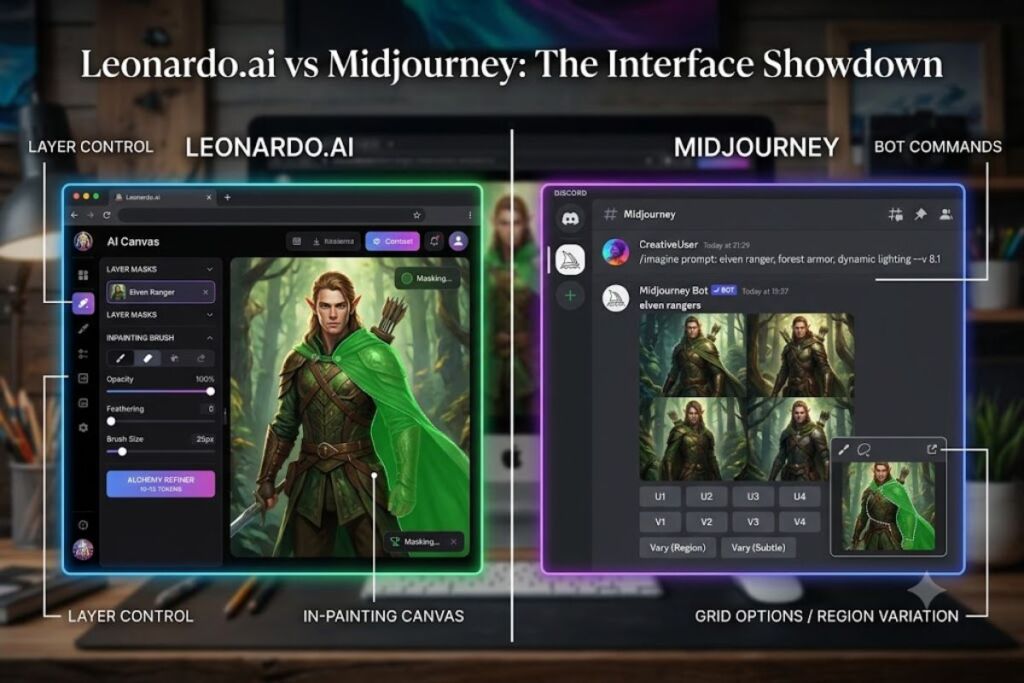
Leonardo.ai and Midjourney solve the same problem — text-to-image generation — with opposite interfaces. Leonardo.ai runs on a browser-based Canvas with layer-level editing controls, while Midjourney runs primarily through Discord slash commands with a newer, lighter web app layer. The choice comes down to how much manual control you need over the final pixel.
What Are Leonardo.ai and Midjourney?
Leonardo.ai is a browser-native AI image platform built around a real-time editing Canvas; Midjourney is a Discord-originated image generator now also accessible through a web Alpha interface. Both convert text prompts into images, but they diverge sharply in interface architecture and editing depth.
| Attribute | Leonardo.ai | Midjourney |
|---|---|---|
| Company | Leonardo Interactive | Midjourney, Inc. |
| Release Year | 2022 | 2022 |
| Primary Interface | Web app with AI Canvas | Discord bot + web Alpha (alpha.midjourney.com) |
| Flagship Model | Phoenix | V8.1 |
| Key Feature | Real-time Canvas with inpainting/outpainting | Discord community feed + Stealth Mode privacy |
| Free Tier | Yes — 150 tokens/day | None since March 2023 |
Leonardo Interactive built the platform around custom model training and game-asset production, which is why the Canvas ships with layer masking and region-based inpainting. Midjourney, Inc. built its reputation on the Discord bot experience — users join the Midjourney server and type slash commands like /image or /gen followed by a prompt, and the bot replies with four options to upscale or vary. Midjourney added a browser-based Alpha interface in 2024, and by the time V8 launched on April 4, 2025, the web platform had become the recommended experience, but the Discord server remains the primary community and history hub for most subscribers. CybernewsFlowith
How Do Leonardo.ai and Midjourney Compare Feature-by-Feature?
Leonardo.ai wins on granular editing control; Midjourney wins on out-of-the-box aesthetic quality. The table below breaks down the six attributes that decide most buying decisions.
| Feature | Leonardo.ai | Midjourney |
|---|---|---|
| Editing environment | Native Canvas: inpainting, outpainting, layer masks | Vary Region inside Discord threads or the web Editor |
| Custom model training | Yes — LoRA training slots on paid tiers | Not available |
| Reference image upload | Drag-and-drop into Canvas | Blend command (web) or URL paste (Discord) |
| Free tier | 150 daily tokens, no credit card | No free tier |
| Commercial license | Included on all paid tiers | Included on paid tiers under $1M annual revenue threshold |
| Community/gallery | Optional public feed on free tier | Public gallery by default in shared Discord channels |
I generated a fantasy character portrait from the prompt “elven ranger, forest armor, dynamic lighting” on both tools. On Leonardo.ai, I opened the Canvas panel, used the Inpaint brush to mask the cloak, and regenerated only that region using Alchemy Refiner — the mask-and-regenerate loop took roughly 12 seconds per pass. On Midjourney, I ran the same prompt through the web Imagine Bar, then used Vary (Region) to select the cloak — the equivalent edit spawned a new result thread and took closer to 45 seconds including the Fast GPU queue wait.
How Much Do Leonardo.ai and Midjourney Cost?
Leonardo.ai starts free and scales to $60/month; Midjourney has no free tier and starts at $10/month, topping out at $120/month. Both offer 20% annual discounts, but the entry cost of actually using each tool differs sharply.
Leonardo.ai pricing (billed monthly), source: official Leonardo.ai pricing page:
- Free: $0/month — 150 tokens/day, public generations, no credit card required
- Apprentice: $12/month ($10/month billed annually) — 8,500 tokens/month
- Artisan: $30/month ($24/month billed annually) — 25,000 tokens/month, unlocks real-time Canvas and LoRA training
- Maestro: $60/month ($48/month billed annually) — 60,000 tokens/month, 6 concurrent generations
Midjourney pricing (billed monthly), source: official Midjourney documentation, verified June 2026:
- Basic: $10/month ($8/month billed annually) — approximately 3.3 Fast GPU hours
- Standard: $30/month ($24/month billed annually) — approximately 15 Fast GPU hours, unlimited Relax Mode
- Pro: $60/month ($48/month billed annually) — approximately 30 Fast GPU hours, adds Stealth Mode
- Mega: $120/month ($96/month billed annually) — approximately 60 Fast GPU hours
Pricing verified as of June 2026.
Leonardo.ai charges per generation using a token system: a standard image consumes 4-6 tokens on the Diffusion XL model, while Alchemy Refiner raises that to 10-15 tokens per image. Midjourney charges per Fast GPU-minute instead of per image — a single still consumes roughly one GPU minute, so the $10 Basic plan’s 3.3 hours cover approximately 200 fast images before forcing a drop into slower Relax Mode.
What Are the Free Tier Limits on Each Tool?
Leonardo.ai gives 150 daily tokens with no credit card required; Midjourney offers zero free generations. This single difference decides which tool a first-time buyer can even test before paying.
Leonardo.ai’s free tier caps daily output at roughly 25-37 standard images using the base Diffusion XL model, dropping to 10-15 images when Alchemy Refiner is active, since that feature consumes 10-15 tokens per generation instead of 4-6. Free-tier images post to Leonardo’s public feed and carry a non-exclusive commercial license rather than full IP ownership. Midjourney removed its trial period in March 2023 and has offered no free credits since — the $10 Basic plan is the only entry point, and it includes full commercial usage rights unless the subscriber’s company exceeds $1 million in annual revenue, in which case Pro or Mega becomes mandatory.
What Are the Pros and Cons of Leonardo.ai?
Leonardo.ai’s biggest strength is Canvas-level editing control; its biggest limitation is output speed under heavy Alchemy use. Both sides trace directly to the token-metered generation model.
Pros:
- Free tier lets new users test Phoenix and PhotoReal models without a credit card
- Canvas supports inpainting, outpainting, and layer masking natively in-browser
- LoRA training slots let users lock in a consistent character or brand style across generations
- Commercial license included starting on the free tier
Cons:
- Alchemy Refiner burns 10-15 tokens per image, cutting Apprentice-tier output to roughly 700 images/month instead of the advertised 1,400-2,100 — switching to Artisan’s larger token pool resolves this for anyone generating past week two of the month.
- Free-tier images post publicly by default, exposing work-in-progress art — private generations require upgrading to a paid tier.
- Relax mode queue depth on Apprentice caps at 5 jobs, causing visible wait spikes during high-traffic hours — Artisan and Maestro raise the queue depth and add priority processing.
What Are the Pros and Cons of Midjourney?
Midjourney’s strength is default aesthetic quality straight out of the prompt bar; its limitation is the Discord-rooted workflow that still shapes how most subscribers organize their work. Both trace back to the platform’s chat-native origins.
Pros:
- V8.1 produces stronger default composition and lighting than Leonardo’s base Diffusion XL model without prompt tuning
- Unlimited Relax Mode on Standard and above removes hard generation caps
- Stealth Mode (Pro and Mega) hides generations from the public gallery entirely
- Web Alpha interface now supports drag-and-drop reference uploads and a searchable Gallery
Cons:
- No free tier means new users commit $10 before generating a single test image — Leonardo’s free tier is the practical way to trial prompt style before paying for Midjourney.
- Fast GPU hours run out mid-month on Basic’s 3.3-hour allotment, forcing a drop to slower Relax Mode that can take 3-5 minutes per image — upgrading to Standard’s 15 hours largely eliminates this for regular users. FluxNote
- No native layer masking; regional edits route through Vary (Region), which spawns a new result thread rather than editing in place — the web Editor closes some of this gap but still lacks Leonardo’s persistent Canvas layers.
Choose Leonardo.ai If You Need These Things
- You want to test the platform before paying, using the 150-token daily free plan
- You need in-browser layer masking and region-specific inpainting for iterative edits
- You train custom LoRA models to lock in a consistent character or brand asset
- You produce game textures, 3D assets, or product renders requiring PhotoReal precision
Choose Midjourney If You Need These Things
- You prioritize default aesthetic quality over manual editing depth
- You need Stealth Mode to keep client work private from the public gallery
- You already work inside Discord communities and want generation history tied to that ecosystem
- You produce high volumes of stylized concept art where V8.1’s default output needs minimal touch-up
Who Should Use Leonardo.ai vs Midjourney?
Solo game developers and brand-asset designers get more value from Leonardo.ai’s Canvas and LoRA training; digital illustrators and concept artists optimizing for speed-to-aesthetic get more value from Midjourney’s V8.1 defaults. Agencies running both stills and short-form video should evaluate Leonardo’s Maestro tier against Midjourney’s Mega tier separately, since Leonardo bundles Motion video generation starting at the Artisan tier while Midjourney sells GPU time that covers both images and video from the same pool.
What Are the Best Alternatives to Leonardo.ai and Midjourney?
- Adobe Firefly — integrates directly into Photoshop and Illustrator for teams already inside the Adobe ecosystem.
- Stable Diffusion — free and self-hostable, but requires local GPU setup and manual model management.
- GPT Image 2 — bundled into ChatGPT Plus at $20/month, trading standalone editing depth for conversational prompt refinement.
Frequently Asked Questions
Does Leonardo.ai have a free plan?
Yes. Leonardo.ai’s free tier includes 150 tokens per day, no credit card required, covering roughly 25-37 standard images depending on the model used.
Does Midjourney require Discord?
No longer exclusively. Midjourney’s web Alpha at alpha.midjourney.com supports full generation and editing, though Discord remains the platform’s original community and history hub.
Which tool is cheaper for beginners?
Leonardo.ai, because its free tier requires no payment. Midjourney’s cheapest option is the $10/month Basic plan with no free alternative.
Can I use images from either tool commercially?
Yes on paid tiers for both. Leonardo.ai grants full commercial rights on paid plans; Midjourney grants commercial rights on all paid tiers unless the subscriber’s company exceeds $1 million in annual revenue, which requires Pro or Mega.
Leonardo.ai’s Canvas justifies its price for anyone editing images after generation; Midjourney’s $10 Basic plan justifies its price for anyone who wants strong output with zero editing at all.