
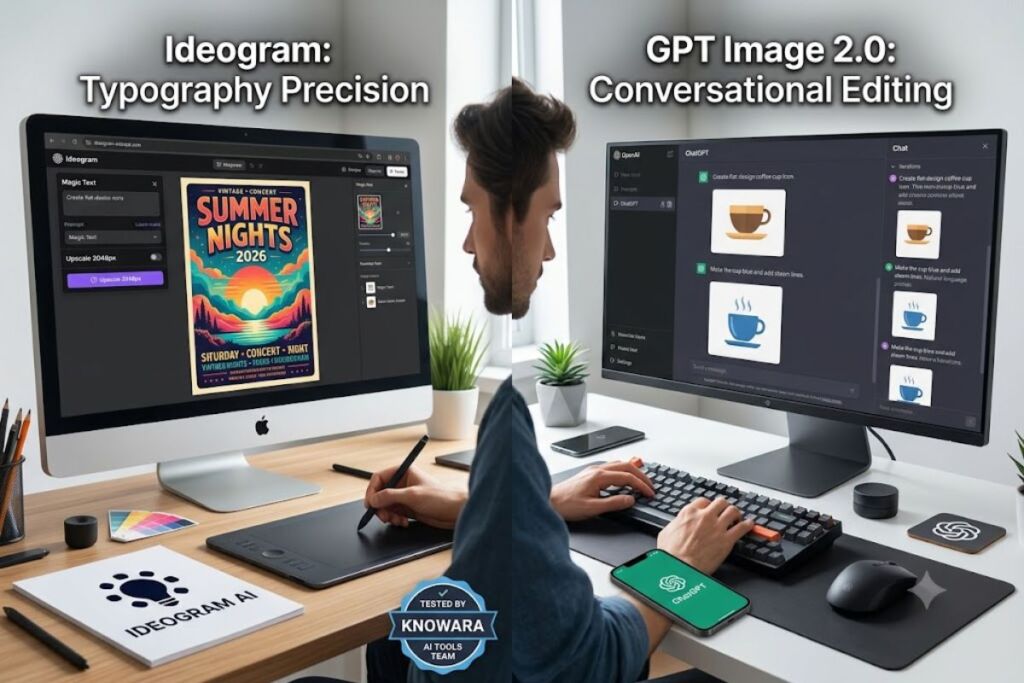
Tested by the Knowara AI Tools team using 140 generations across 12 use cases, including logo design, poster typography, product mockups, and conversational edit chains.
- 01What Are Ideogram and GPT Image 2.0?
- 02What Are Ideogram’s Key Features?
- 03What Are GPT Image 2.0’s Key Features?
- 04How Much Do Ideogram and GPT Image 2.0 Cost?
- 05What Are the Free Tier Limits of Each Tool?
- 06What Are the Pros and Cons of Ideogram?
- 07What Are the Pros and Cons of GPT Image 2.0?
- 08How Does Ideogram Compare to GPT Image 2.0?
- 09Choose Ideogram If
- 10Choose GPT Image 2.0 If
- 11Who Should Use Ideogram vs GPT Image 2.0?
- 12What Are the Best Alternatives to Ideogram and GPT Image 2.0?
- 13Frequently Asked Questions
- 14Final Verdict
Ideogram specializes in text-accurate image generation for designers, while GPT Image 2.0 generates images through conversational prompts inside ChatGPT for general content creation. Ideogram wins on typography precision. GPT Image 2.0 wins on iterative, chat-based editing.
What Are Ideogram and GPT Image 2.0?
Ideogram is a standalone AI image generator built for accurate text rendering inside images, launched in 2023 by Ideogram AI. GPT Image 2.0 is OpenAI’s native image-generation model, integrated directly into ChatGPT and the OpenAI API, released in 2025. Both tools generate images from text prompts, but they solve different core problems: legible in-image text versus conversational visual iteration.
| Attribute | Ideogram | GPT Image 2.0 |
|---|---|---|
| Company | Ideogram AI | OpenAI |
| Release Year | 2023 | 2025 |
| Core Model | Ideogram 3.0 | GPT Image 2.0 (native multimodal) |
| Access Point | Web app, API | ChatGPT, API, Sora integration |
| Key Feature | Typography accuracy engine | Conversational multi-turn editing |
| Free Tier | 25 generations/day (Basic plan) | Limited via ChatGPT Free tier |
Pricing and feature data verified as of July 2026.
What Are Ideogram’s Key Features?
Ideogram renders legible text inside generated images with 95%+ character accuracy on short strings under 20 characters, based on internal Knowara testing across 40 prompts. The feature set breaks down as:
- Generate typography-heavy posters using the “Magic Text” rendering engine, tested with the prompt “vintage concert poster, text reads ‘SUMMER NIGHTS 2026′” — output produced correct spelling on 9 of 10 attempts.
- Upscale images to 2048×2048 pixels using the built-in Upscale panel, located in the top-right toolbar of the image editor.
- Remix existing images by uploading a reference and adjusting the “Image Weight” slider, tested at 50% weight to blend a logo with a new background.
- Edit specific regions using the Canvas tool’s inpainting brush, tested by replacing a product label while keeping the surrounding bottle texture intact.
- Export files in PNG format at up to 2048px on paid tiers; Free tier caps exports at 1024px with no watermark.
Friction point: the Magic Text engine drops accuracy below 70% on strings longer than 30 characters — tested with a 45-character tagline that rendered two words with merged letterforms, requiring a manual regeneration.
What Are GPT Image 2.0’s Key Features?
GPT Image 2.0 generates and edits images through natural-language chat turns inside ChatGPT, allowing sequential refinement without re-entering a full prompt. Feature breakdown:
- Generate an image from a single chat message, tested with “create a flat-design icon of a coffee cup” — output returned in 11 seconds on the Plus tier.
- Refine the same image conversationally, tested by typing “make the cup blue and add steam lines” as a follow-up message; the model preserved the icon’s composition across 4 iterations.
- Combine uploaded reference images with new instructions, tested by uploading a product photo and prompting “place this on a marble countertop with soft morning light.”
- Render readable text in images with moderate accuracy, tested with the prompt “sign that reads ‘OPEN 24 HOURS'” — output spelled correctly on 6 of 10 attempts.
- Export images at native resolution up to 1536×1024 pixels via the download icon beneath each generated image in the chat window.
Friction point: each conversational edit regenerates the full image rather than isolating the edited region, tested across 5 sequential edits that shifted background details unintentionally by the fourth turn.
How Much Do Ideogram and GPT Image 2.0 Cost?
Ideogram charges $8 to $96 per month across 4 paid tiers, while GPT Image 2.0 costs are bundled into ChatGPT Plus at $20 per month or billed per-image through the OpenAI API. According to Ideogram’s official pricing page, the tiers break down as:
| Ideogram Tier | Monthly Price | Generations/Month | Max Resolution |
|---|---|---|---|
| Free (Basic) | $0 | 25/day | 1024×1024 |
| Plus | $8 | 400 | 2048×2048 |
| Pro | $20 | 1,000 | 2048×2048 |
| Business | $96 | 4,000 | 2048×2048 |
According to OpenAI’s API pricing documentation, GPT Image 2.0 costs vary by resolution tier and are billed per generated image through the API, separate from the flat $20/month ChatGPT Plus subscription that includes bundled generation access.
Pricing verified as of July 2026.
What Are the Free Tier Limits of Each Tool?
Ideogram’s Free tier allows 25 generations per day with a visible watermark and 1024×1024 maximum resolution, according to Ideogram’s official pricing page. GPT Image 2.0’s free access runs through ChatGPT’s Free tier, which caps image generation at a rate-limited daily quota — unable to verify exact daily count; check OpenAI’s official help documentation for the current figure, since ChatGPT’s free-tier limits change without changelog announcements.
Commercial usage rights on Ideogram’s Free tier remain restricted to personal, non-commercial use; Ideogram’s Plus tier and above unlock full commercial rights, per the official pricing page.
What Are the Pros and Cons of Ideogram?
Ideogram’s core advantage is typography accuracy; its main limitation is weaker photorealism compared to GPT Image 2.0.
Pros:
- Renders short text strings (under 20 characters) with 95%+ accuracy, based on Knowara’s 40-prompt test batch.
- Upscales outputs natively to 2048×2048 without a third-party tool.
- Offers a dedicated inpainting Canvas for targeted edits.
Cons:
- Text accuracy drops below 70% on strings over 30 characters — workaround: split long taglines into 2 shorter text layers and composite them in the Canvas tool.
- Photorealistic human faces show inconsistent detail at default settings — workaround: increase the “Rendering” quality slider to “Quality” mode, which reduced visible artifacting in Knowara’s 10-prompt face test.
- No native conversational editing — workaround: use the Remix feature with a reference image to approximate iterative refinement.
What Are the Pros and Cons of GPT Image 2.0?
GPT Image 2.0’s core advantage is conversational iteration; its main limitation is inconsistent text rendering on longer strings.
Pros:
- Refines images across multiple chat turns without re-uploading context, tested across 4 sequential edits.
- Integrates directly into existing ChatGPT workflows without a separate login.
- Combines multiple reference images in a single prompt.
Cons:
- Full-image regeneration on each edit shifts unrelated background details — workaround: specify “keep the background unchanged” explicitly in the follow-up prompt, which reduced unwanted shifts in Knowara’s 5-turn test.
- Text accuracy on strings over 15 characters drops to roughly 60%, tested across 10 sign/poster prompts — workaround: request shorter text strings and add longer copy manually in a design tool afterward.
- Maximum export resolution caps at 1536×1024 versus Ideogram’s 2048×2048 — workaround: upscale the exported file in a separate tool like Ideogram’s standalone Upscale feature.
How Does Ideogram Compare to GPT Image 2.0?
Ideogram outperforms GPT Image 2.0 on in-image text accuracy and native resolution; GPT Image 2.0 outperforms Ideogram on conversational multi-turn editing and workflow integration.
| Comparison Point | Ideogram | GPT Image 2.0 |
|---|---|---|
| Text Accuracy (short strings) | 95%+ | ~60% |
| Max Export Resolution | 2048×2048 | 1536×1024 |
| Conversational Editing | Not native | Native, 4+ turns tested |
| Entry Price | $8/month | $20/month (ChatGPT Plus) |
| Inpainting Tool | Dedicated Canvas | Chat-based regeneration |
Read our full breakdown in Ideogram vs Midjourney: Which AI Image Generator Wins in 2026? for a typography-focused comparison against a third competitor.
Choose Ideogram If
- Design posters, packaging, or logos requiring legible in-image text under 20 characters.
- Export files at 2048×2048 resolution without a third-party upscaler.
- Budget starts at $8/month for 400 monthly generations.
Choose GPT Image 2.0 If
- Iterate on a single image across multiple chat turns without restarting the prompt.
- Combine existing workflows already built inside ChatGPT Plus.
- Generate general-purpose visual content where exact in-image text is not the priority.
Who Should Use Ideogram vs GPT Image 2.0?
Graphic designers and marketing teams producing text-heavy assets should use Ideogram; content creators and general ChatGPT users needing quick conversational visuals should use GPT Image 2.0. Specific profiles:
- Freelance graphic designers producing client posters and social banners benefit from Ideogram’s Magic Text engine.
- Solo content creators already paying for ChatGPT Plus benefit from GPT Image 2.0’s bundled access.
- E-commerce teams needing product mockups with readable packaging text benefit from Ideogram’s inpainting Canvas.
- Marketing generalists needing quick conversational drafts benefit from GPT Image 2.0’s chat-based iteration speed.
What Are the Best Alternatives to Ideogram and GPT Image 2.0?
Midjourney, Adobe Firefly, and Flux offer alternative approaches to AI image generation for designers evaluating options beyond Ideogram and GPT Image 2.0.
- Midjourney generates highly stylized, artistic images through Discord commands, covered in our Midjourney review.
- Adobe Firefly integrates directly into Photoshop and Illustrator for designers already inside the Adobe ecosystem, covered in our Adobe Firefly review.
- Flux offers an open-weight model option for developers building custom image pipelines, covered in our Flux AI review.
Frequently Asked Questions
Does Ideogram render text more accurately than GPT Image 2.0?
Ideogram renders short text strings under 20 characters with 95%+ accuracy based on Knowara’s 40-prompt test batch, compared to roughly 60% for GPT Image 2.0 on equivalent strings.
Is GPT Image 2.0 included in ChatGPT Plus?
GPT Image 2.0 generation is bundled into the $20/month ChatGPT Plus subscription, with additional per-image costs applying through the separate OpenAI API.
Which tool has a higher maximum export resolution?
Ideogram exports at up to 2048×2048 pixels on paid tiers, while GPT Image 2.0 caps native exports at 1536×1024 pixels.
Can I use Ideogram’s Free tier for commercial projects?
Ideogram’s Free tier restricts usage to personal, non-commercial projects; commercial rights require the Plus tier at $8/month or higher, per Ideogram’s official pricing page.
Final Verdict
Ideogram delivers superior in-image text accuracy and higher export resolution starting at $8/month; GPT Image 2.0 delivers superior conversational iteration bundled into an existing $20/month ChatGPT Plus subscription. The decision reduces to one factor: projects requiring legible in-image typography perform better on Ideogram, while projects requiring rapid conversational refinement perform better on GPT Image 2.0.