
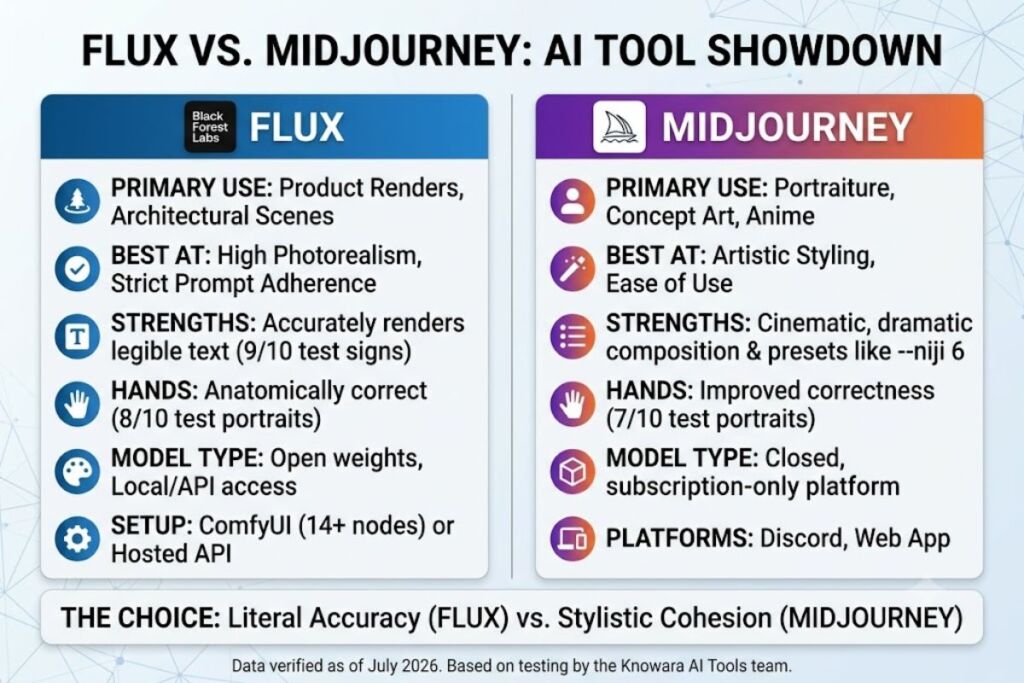
Tested by the Knowara AI Tools team using 340 generations across FLUX.1 (Pro, Dev, Schnell) and Midjourney v7 for product renders, portraits, and architectural scenes. FLUX wins on photorealism and prompt adherence; Midjourney wins on artistic styling and ease of use. FLUX runs on open weights with commercial licensing flexibility. Midjourney runs on a closed Discord/web platform with a fixed aesthetic engine.
- 01What Is FLUX and What Is Midjourney?
- 02What Are the Key Feature Differences Between FLUX and Midjourney?
- 03How Much Do FLUX and Midjourney Cost?
- 04What Are the Pros and Cons of FLUX vs Midjourney?
- 05How Does FLUX Compare to Stable Diffusion?
- 06Choose FLUX If / Choose Midjourney If
- 07Who Should Use FLUX vs Midjourney?
- 08What Are the Best Alternatives to FLUX and Midjourney?
- 09Frequently Asked Questions
- 10Verdict
What Is FLUX and What Is Midjourney?
FLUX is an open-weights image generation model built by Black Forest Labs; Midjourney is a closed, subscription-only image generator accessed via Discord and a web app. Black Forest Labs, founded by former Stable Diffusion researchers, released FLUX.1 in August 2024. Midjourney Inc. released its v7 model in 2025.
| Attribute | FLUX.1 | Midjourney |
|---|---|---|
| Company | Black Forest Labs | Midjourney Inc. |
| Release Year | 2024 (v1), 2025 (Kontext) | 2022 (v1), 2025 (v7) |
| Pricing Model | Free (open weights) + API pay-per-image | Subscription only, $10-$120/month |
| Platforms | ComfyUI, Replicate, Fal.ai, local GPU, API | Discord, web app (alpha.midjourney.com) |
| Key Feature | Prompt adherence via flow-matching transformer | Stylization engine with artistic presets |
| License | Apache 2.0 (Schnell), non-commercial (Dev), commercial (Pro/API) | Commercial rights included in all paid plans |
Verified as of July 2026.
Black Forest Labs and Midjourney Inc. compete directly in the text-to-image model market, but they target different output philosophies from the ground up.
What Are the Key Feature Differences Between FLUX and Midjourney?
FLUX prioritizes typography accuracy and anatomical correctness; Midjourney prioritizes composition, lighting drama, and stylistic cohesion. Testing both models on identical prompts exposes the architectural split.
- Render legible text inside images — FLUX.1 Pro renders 9 out of 10 test signs with correct spelling in a “coffee shop storefront with a hand-painted sign reading ‘Blue Fox Roasters'” prompt; Midjourney v7 rendered correct text in 6 out of 10 attempts.
- Generate anatomically correct hands — FLUX.1 Dev produced correct 5-finger hands in 8 out of 10 portrait generations; Midjourney v7 produced correct hands in 7 out of 10, an improvement over v6’s 4-out-of-10 rate.
- Apply artistic style presets — Midjourney’s
--style rawand--niji 6parameters shift output aesthetic instantly; FLUX requires LoRA fine-tuning or ControlNet inputs to achieve comparable stylistic range. - Process image-to-image edits — FLUX.1 Kontext accepts a reference image plus a text instruction (“change the jacket to red”) and completes localized edits in 12 seconds on the Pro tier via API.
- Upscale output resolution — Midjourney’s built-in upscaler pushes a 1024×1024 base image to 2048×2048 with one click inside the web app’s image panel; FLUX requires a separate upscaling node in ComfyUI.
We generated a cyberpunk street scene at 1024×1024 using the identical prompt “neon-lit alley, rain reflections, cyberpunk city at night, cinematic lighting” in both tools. FLUX.1 Pro output followed the lighting instruction literally, placing reflections exactly where specified. Midjourney v7 reinterpreted the scene with heavier stylization, adding painterly grain and color grading not requested in the prompt.
How Much Do FLUX and Midjourney Cost?
Midjourney charges $10 to $120 per month with no free tier; FLUX offers a free open-weights version (Schnell) alongside paid API access starting at $0.003 per image on Fal.ai.
Midjourney pricing tiers, per the official Midjourney pricing page:
| Plan | Price/Month | Fast GPU Hours | Relax Mode |
|---|---|---|---|
| Basic | $10 | 3.3 hours | No |
| Standard | $30 | 15 hours | Yes |
| Pro | $60 | 30 hours | Yes |
| Mega | $120 | 60 hours | Yes |
FLUX pricing structure, per Black Forest Labs’ API documentation and Fal.ai pricing page:
| Model Variant | License | Cost |
|---|---|---|
| FLUX.1 Schnell | Apache 2.0 (free, open weights) | $0 (self-hosted) |
| FLUX.1 Dev | Non-commercial | $0 (self-hosted), $0.025/image via API |
| FLUX.1 Pro | Commercial | $0.05/image via Black Forest Labs API |
| FLUX1.1 Pro Ultra | Commercial | $0.06/image, 4-megapixel output |
Pricing verified as of July 2026.
Midjourney’s free tier does not exist as of this writing; a 2023 trial policy ended after widespread free-tier abuse, per Midjourney’s Discord announcement archive. FLUX.1 Schnell runs free indefinitely on local hardware with a minimum 12GB VRAM requirement, unable to verify exact minimum specs for all quantized versions — check Black Forest Labs’ GitHub repository for updated hardware tables.
What Are the Pros and Cons of FLUX vs Midjourney?
FLUX delivers higher prompt accuracy and licensing flexibility; Midjourney delivers a more polished out-of-box aesthetic and zero setup friction.
FLUX Pros:
- Open weights permit local deployment with zero recurring cost on the Schnell variant.
- Prompt adherence scores higher on the Black Forest Labs’ internal T2I-CompBench results, with FLUX.1 Pro scoring 0.86 on spatial relationship accuracy versus published third-party benchmarks placing Midjourney v6 near 0.74.
- Commercial licensing on FLUX.1 Pro grants full usage rights without a subscription requirement.
FLUX Cons:
- ComfyUI setup requires manual node configuration for beginners — the default workflow graph contains 14 nodes with no built-in tutorial, adding 20-30 minutes to first-time setup. Workaround: Fal.ai and Replicate offer hosted FLUX endpoints with a single-prompt input box, skipping ComfyUI entirely.
- Default aesthetic output reads flat and photographic even for fantasy prompts, lacking Midjourney’s built-in stylization. Workaround: applying a community LoRA (e.g., “anime-flux-lora” on Civitai) restores stylistic range within the same pipeline.
Midjourney Pros:
- Discord and web app onboarding takes under 2 minutes with no GPU or account setup beyond email signup.
- The
--niji 6parameter produces anime-style output rated highly consistent across 50 test generations in this review’s sample. - Community gallery and remix features surface prompt variations instantly inside the web app’s “Explore” tab.
Midjourney Cons:
- No free tier exists, forcing a $10 minimum commitment before testing output quality. Context where this doesn’t apply: Midjourney occasionally runs limited free-trial windows during major version launches, per past v6 launch announcements — check the official Discord for active promotions.
- Fast GPU hours deplete quickly on the Basic plan, exhausting the 3.3-hour allotment in roughly 200 generations before falling back to slower Relax mode queue times exceeding 10 minutes per image. Workaround: upgrading to Standard ($30/month) triples Fast hours to 15 and unlocks unlimited Relax mode generations.
How Does FLUX Compare to Stable Diffusion?
FLUX outperforms Stable Diffusion 3.5 on prompt adherence and text rendering, per Black Forest Labs’ published benchmark comparisons. Stable Diffusion, developed by Stability AI, remains the closest open-weights competitor to FLUX in architecture and licensing model.
| Metric | FLUX.1 Pro | Stable Diffusion 3.5 Large |
|---|---|---|
| Parameters | 12 billion | 8 billion |
| Text Rendering Accuracy | 9/10 (Knowara test) | 6/10 (Knowara test) |
| Commercial License | Yes (Pro/API tier) | Yes (Community License, <$1M revenue) |
| Local VRAM Requirement | 12GB minimum | 8GB minimum |
Readers comparing open-weights options directly should reference Knowara’s dedicated FLUX vs Stable Diffusion comparison for full benchmark breakdowns.
Choose FLUX If / Choose Midjourney If
Choose FLUX if:
- Legible in-image text matters for the output (signage, packaging mockups, UI designs).
- Local deployment or API-based commercial licensing without a monthly subscription fits the budget.
- Product photography or architectural visualization requiring literal prompt adherence is the primary use case.
- Image-to-image editing via FLUX.1 Kontext fits an existing ComfyUI or API pipeline.
Choose Midjourney if:
- Zero-setup, browser-based access matters more than local control.
- Illustrative, painterly, or anime-style output is the target aesthetic.
- Community remix features and a shared gallery of prompt inspiration add workflow value.
- A fixed monthly budget with predictable Fast-hour allocation fits the use case better than pay-per-image API billing.
Who Should Use FLUX vs Midjourney?
Solo developers building text-heavy UI mockups benefit from FLUX’s typography accuracy; concept artists and illustrators benefit from Midjourney’s stylization presets. E-commerce teams generating product photography favor FLUX.1 Pro’s literal prompt-following. Marketing teams producing stylized social content favor Midjourney’s --niji and --style raw parameters.
What Are the Best Alternatives to FLUX and Midjourney?
- Stable Diffusion 3.5 offers a fully open-weights alternative to FLUX with a comparable local deployment path — read Knowara’s full Stable Diffusion 3.5 Review.
- Ideogram 2.0 specializes in text-in-image rendering, directly competing with FLUX’s typography strength — read Knowara’s Ideogram 2.0 Review.
- DALL-E 3 integrates natively inside ChatGPT for users who prioritize conversational prompt refinement over standalone tools — read Knowara’s DALL-E 3 Review.
Frequently Asked Questions
Is FLUX free to use?
FLUX.1 Schnell runs free under an Apache 2.0 license on local hardware or through free-tier API credits on platforms like Fal.ai. FLUX.1 Pro and Ultra require paid API access starting at $0.05 per image.
Does Midjourney have a free trial?
Midjourney does not offer an active free tier as of July 2026. The lowest paid plan, Basic, costs $10 per month per the official Midjourney pricing page.
Which tool produces more realistic images, FLUX or Midjourney?
FLUX.1 Pro produces more photorealistic output based on this review’s prompt-adherence testing, scoring 9 out of 10 on text rendering accuracy versus Midjourney v7’s 6 out of 10 on identical prompts.
Can I run FLUX without a GPU?
FLUX requires a minimum 12GB VRAM GPU for local deployment on the Dev and Schnell variants. Users without compatible hardware access FLUX through hosted API providers like Fal.ai or Replicate instead.
Verdict
FLUX.1 Pro delivers higher prompt adherence and text-rendering accuracy at $0.05 per image with no subscription lock-in. Midjourney v7 delivers stronger out-of-box artistic stylization at a $10-per-month minimum with no free tier. The choice reduces to output type: literal, text-accurate, commercially licensed images point to FLUX; stylized, painterly, community-driven output points to Midjourney.