
Nano Banana Pro is Google’s flagship AI image generation and editing model, built on the Gemini 3 Pro architecture. Google released it on November 20, 2025, inside the Gemini app, Google AI Studio, and Vertex AI. It adds 4K output, 14-image fusion, and Search-grounded accuracy on top of the original Nano Banana model.
- 01What Is Nano Banana Pro?
- 02What Are Nano Banana Pro’s Key Features?
- 03How Much Does Nano Banana Pro Cost?
- 04What Are the Pros and Cons of Nano Banana Pro?
- 05How Does Nano Banana Pro Compare to Midjourney V7?
- 06Who Should Use Nano Banana Pro?
- 07What Are the Best Alternatives to Nano Banana Pro?
- 08Frequently Asked Questions
What Is Nano Banana Pro?
Nano Banana Pro is Google DeepMind’s most advanced image model, running on Gemini 3 Pro’s reasoning core. It plans a scene’s composition before rendering it, then generates the final image — a workflow Google calls “Thinking” mode.
The model extends the original Nano Banana (Gemini 2.5 Flash Image) with deeper multimodal reasoning, real-world grounding through Google Search, and higher-fidelity visual synthesis. It generates infographics, diagrams, product composites, and cinematic scenes, and it activates automatically inside the Gemini app when a user selects “Create images” with the Thinking option enabled.
| Attribute | Value |
|---|---|
| Company | Google DeepMind |
| Release Date | November 20, 2025 |
| Underlying Model | Gemini 3 Pro (model ID: gemini-3-pro-image-preview) |
| Platforms | Gemini app (Web, iOS, Android), Google AI Studio, Vertex AI, Gemini API |
| Context Window | 65,536 tokens |
| Max Output | 32,768 tokens (up to 4K resolution) |
| Key Feature | “Thinking” mode — plans scene composition before generating |
| Free Tier Limit | 2 images per day in the Gemini app (as of December 2025) |
What Are Nano Banana Pro’s Key Features?
Nano Banana Pro’s feature set separates it from the standard Nano Banana model and from competing image generators.
- Renders long-form and multilingual text inside images at 94–96% accuracy, according to AI Free API’s testing.
- Blends up to 14 reference images into a single composite scene, versus 2–3 images in the standard Nano Banana model.
- Preserves character identity across up to 5 distinct subjects within one generation.
- Outputs resolutions up to 4096×4096 pixels (4K), consuming 2,000 tokens per image at that tier, per Google Cloud’s documentation.
- Grounds generations in real-time Google Search data, enabling accurate weather maps, current-event graphics, and factual diagrams.
- Embeds an invisible SynthID watermark in every generated image’s pixel data for provenance verification.
- Applies localized edits, lighting adjustments, focus changes, and camera-angle transformations without regenerating the full image.
- Plans spatial layout and composition before rendering, reducing the layout errors common in the earlier Nano Banana model.
How Much Does Nano Banana Pro Cost?
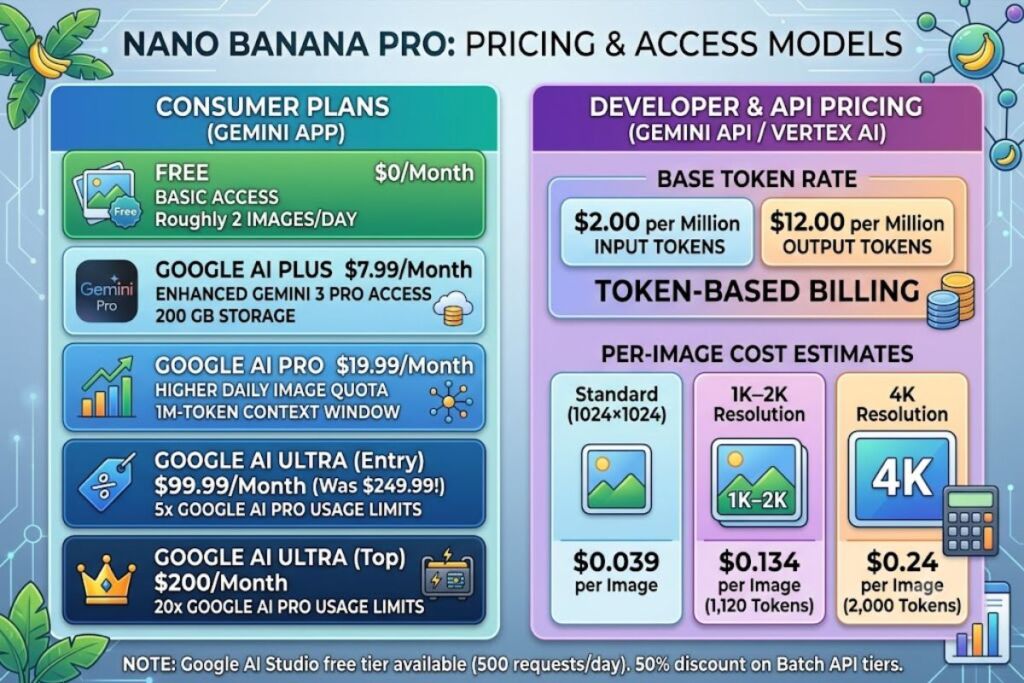
Nano Banana Pro costs $0 through the free Gemini app tier (2 images per day) up to $200 per month on Google AI Ultra, or $2.00 per million input tokens / $12.00 per million output tokens through the API, according to Google’s official Gemini pricing structure.
Consumer plans (Gemini app):
| Plan | Price | Nano Banana Pro Access |
|---|---|---|
| Free | $0/month | Basic access, roughly 2 images/day (reduced from 3 in November 2025) |
| Google AI Plus | $7.99/month | Enhanced Gemini 3 Pro access, 200 GB storage |
| Google AI Pro | $19.99/month | 1M-token context window, higher daily image quota |
| Google AI Ultra (entry) | $99.99/month | 5x Google AI Pro’s usage limits |
| Google AI Ultra (top) | $200/month | 20x Google AI Pro’s usage limits |
Google cut Google AI Ultra’s entry price from $249.99 to $99.99 per month at Google I/O 2026 in May 2026, while keeping the same feature set.
Developer pricing (Gemini API / Vertex AI):
- $2.00 per million input tokens, $12.00 per million output tokens
- Standard (1024×1024) image: $0.039 per image
- 1K–2K resolution image (1,120 tokens): $0.134 per image
- 4K resolution image (2,000 tokens): $0.24 per image
- Batch API: 50% discount on every tier above
- Google AI Studio free tier: 500 requests per day
What Are the Pros and Cons of Nano Banana Pro?
Nano Banana Pro’s biggest advantage is cost-per-image at frontier quality; its biggest drawback is a shrinking free daily quota.
Pros:
- Ranks #27 of 525 published models on Design for Online’s overall intelligence leaderboard, placing it in the “Professional” tier.
- Delivers 94–96% text-rendering accuracy inside generated images, ahead of most competing models on that specific metric.
- Offers a genuine free tier (2 images/day) at a time when Midjourney has sold no free trial since March 2023.
- Generates a standard-resolution image in 2–5 seconds.
Cons:
- At $2.00/$12.00 per million tokens, Design for Online ranks it “among the most expensive” models on a pure token-price basis.
- The free daily quota dropped from 5 prompts and 3 images in November 2025 to 2 images by December 2025, according to GSMArena and AI Free API.
- Falls back silently to the lower-quality standard Nano Banana model once the daily quota is exhausted, with no warning shown to the user.
How Does Nano Banana Pro Compare to Midjourney V7?
Nano Banana Pro wins on cost and text accuracy; Midjourney V7 wins on artistic and cinematic style control.
| Attribute | Nano Banana Pro | Midjourney V7 |
|---|---|---|
| Company | Google DeepMind | Midjourney Inc. |
| Entry Price | Free (2 images/day) | $10/month (no free tier) |
| Top Plan | $200/month (Google AI Ultra) | $120/month (Mega) |
| Max Resolution | 4096×4096 (4K) | Upscaled outputs, GPU-hour billed |
| Billing Model | Per-token / subscription quota | Fast GPU-hours per subscription tier |
| Standout Strength | In-image text rendering, multi-image fusion | Cinematic aesthetics, Omni Reference character consistency |
Midjourney V7 charges $10 to $120 per month across four tiers with no free trial since March 2023, and it bills fast GPU-hours rather than a fixed image count. For a full feature-by-feature breakdown, see our Nano Banana Pro vs Midjourney V7 Comparison.
Who Should Use Nano Banana Pro?
- Marketing teams producing on-brand infographics that require accurate embedded text and multilingual layouts.
- Solo content creators who want frontier-quality image generation without a paid subscription.
- Developers building apps that call the Gemini API programmatically at a sub-$0.04 cost per standard image.
- Enterprise teams on Vertex AI that need VPC Service Controls, CMEK, and data-residency compliance alongside image generation.
What Are the Best Alternatives to Nano Banana Pro?
- Midjourney V7 — the closest competitor on artistic quality, priced from $10 to $120 per month with no free tier. Read our Midjourney V7 Review.
- Nano Banana 2 (Gemini 3.1 Flash Image) — Google’s faster, cheaper sibling model at $0.055 per image, built for high-volume, lower-stakes generation. Read our Nano Banana 2 Review.
- GPT Image 2 — OpenAI’s image model, positioned for reference-image editing and format-ready output. Read our GPT Image 2 Review.
Frequently Asked Questions
Is Nano Banana Pro free to use?
Yes. The Gemini app grants free users roughly 2 images per day as of December 2025, after which the app switches to the standard Nano Banana model.
What is the difference between Nano Banana Pro and Nano Banana 2?
Nano Banana Pro runs on Gemini 3 Pro with 4K output and 14-image fusion; Nano Banana 2 runs on the faster, cheaper Gemini 3.1 Flash Image model at $0.055 per image.
Does Nano Banana Pro watermark its images?
Yes. Every image carries an invisible SynthID watermark embedded in the pixel data, detectable through Google’s verification tools but invisible to the eye.
What is the maximum resolution Nano Banana Pro supports?
4096×4096 pixels (4K), consuming 2,000 tokens per image through the Gemini API.