
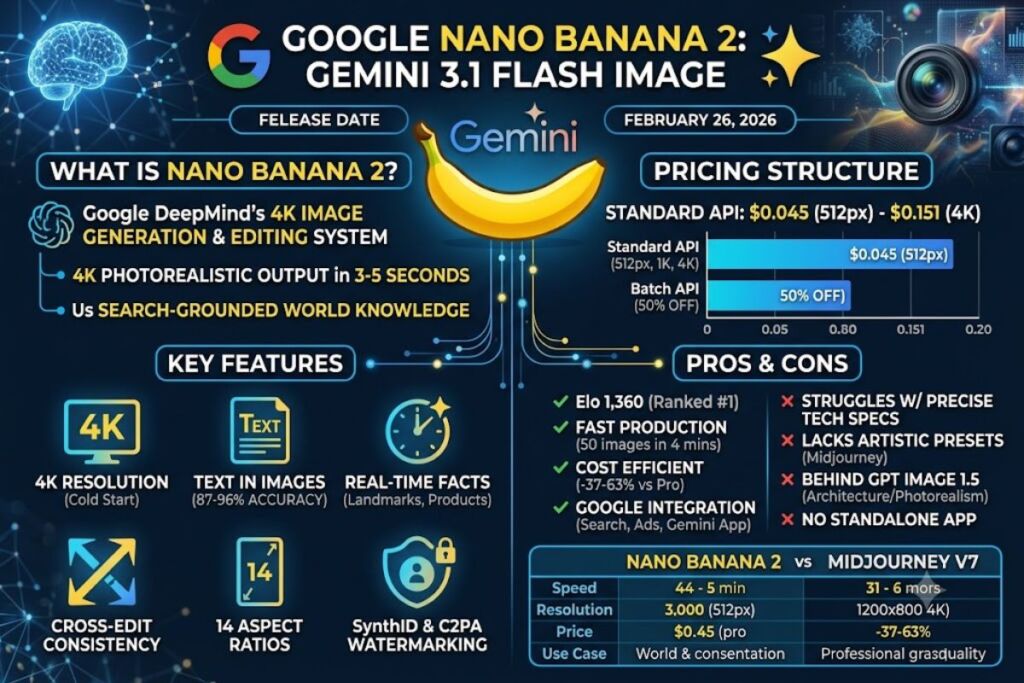
Nano Banana 2 is Google’s fourth-generation Gemini image model, released on February 26, 2026, under the official name Gemini 3.1 Flash Image. It generates 4K-resolution images in 3 to 5 seconds, combines Nano Banana Pro’s image quality with Gemini Flash-tier inference speed, and prices standard output between $0.045 and $0.151 per image through the Gemini API.
- 01What Is Nano Banana 2?
- 02What Are Nano Banana 2’s Key Features?
- 03How Much Does Nano Banana 2 Cost?
- 04What Are the Pros and Cons of Nano Banana 2?
- 05How Does Nano Banana 2 Compare to Midjourney V7?
- 06Who Should Use Nano Banana 2?
- 07What Are the Best Alternatives to Nano Banana 2?
- 08Frequently Asked Questions
What Is Nano Banana 2?
Nano Banana 2 is Google DeepMind’s Gemini 3.1 Flash Image model, an image generation and editing system that produces 4K photorealistic output in 3 to 5 seconds while pulling real-time world knowledge from Gemini’s search-grounded architecture.
Google DeepMind released Nano Banana 2 on February 26, 2026, positioning it between two earlier releases in the same product line: the original Nano Banana (Gemini 2.5 Flash Image, launched August 2025) and Nano Banana Pro (launched November 2025). Nano Banana 2 merges Nano Banana Pro’s advanced world knowledge and instruction-following with Gemini Flash’s inference speed, according to Google’s official product announcement. The model runs under the API identifier gemini-3.1-flash-image, and Google DeepMind lists it in the Gemini API, Google AI Studio, Vertex AI, and Gemini Enterprise Agent Platform. SynthID invisible watermarking and C2PA Content Credentials tag every output as AI-generated, per Google’s announcement. Gemini, for context, is Google’s family of multimodal AI models that also powers Google Search’s AI Mode, the Gemini chat app, and NotebookLM.
| Attribute | Value |
|---|---|
| Company | Google DeepMind |
| Release Date | February 26, 2026 |
| API Model ID | gemini-3.1-flash-image |
| Pricing | $0.045–$0.151 per image (resolution-dependent) |
| Max Resolution | 4K |
| Platforms | Gemini API, Google AI Studio, Vertex AI, Gemini app, Search AI Mode |
| Key Feature | Search-grounded world knowledge paired with Flash-speed inference |
What Are Nano Banana 2’s Key Features?
Nano Banana 2’s key features include 4K image output, sub-5-second generation speed, search-grounded world knowledge, cross-edit subject consistency, and built-in SynthID watermarking, engineered to close the historical gap between Flash-tier speed and Pro-tier image quality.
- Generate 4K-resolution images in 3 to 5 seconds from a cold start, a jump from the 2K ceiling on Nano Banana Pro.
- Render text inside images at 87% to 96% accuracy, per independent benchmark testing published in AI Free API’s 2026 five-model comparison.
- Pull real-time facts from Gemini’s search-grounded knowledge base to render specific landmarks, products, and public figures with higher factual accuracy than the original Nano Banana.
- Maintain subject and character consistency across sequential edits without requiring manual reference-image weighting.
- Support 14 aspect ratios per generation request, matching the configuration options documented for the Nano Banana model family’s API.
- Embed invisible SynthID watermarks and C2PA Content Credentials in every output to flag AI-generated images.
- Process a 131,072-token context window with a maximum output of 32,768 tokens, per OpenRouter’s published model card for gemini-3.1-flash-image.
How Much Does Nano Banana 2 Cost?
Nano Banana 2 costs $0.045 per image at 512-pixel resolution and $0.151 per image at 4K resolution through the standard Gemini API, with a 50% discount available through Google’s Batch API.
Google prices Nano Banana 2 by output resolution instead of a flat per-image rate. Standard API calls range from $0.045 for 512px output to $0.151 for full 4K output, according to pricing analysis from LaoZhang AI and AI Free API, both of which track Google’s Gemini API pricing documentation. Batch API access cuts every tier by 50%, dropping the floor price to $0.022 per image. Token-based costs apply on top of image output: $0.50 per million input tokens and $3.00 per million output tokens, per OpenRouter’s model listing for gemini-3.1-flash-image. Google AI Studio’s free tier covers developers generating fewer than 300 images per month, per AI Free API’s cost breakdown. Nano Banana Pro, the higher-tier sibling model, costs $0.134 per standard image — roughly double Nano Banana 2’s equivalent rate.
| Tier | Resolution | Price per Image |
|---|---|---|
| Standard API | 512px | $0.045 |
| Standard API | 1024px (1K) | $0.067 |
| Standard API | 4K | $0.151 |
| Batch API | Any tier above | 50% off standard rate |
What Are the Pros and Cons of Nano Banana 2?
Nano Banana 2’s core advantage is 4K output at Flash-tier speed and pricing; its core limitation is inconsistent handling of precise technical specifications and a measurable quality gap versus Midjourney V7 on stylized artistic output.
Pros:
- Scores an Elo rating of 1,360 in AI Free API’s 2026 five-model comparison, ranking above GPT Image 1.5 (1,264) and FLUX.2 Pro (1,265).
- Generates 50 images in approximately 4 minutes, versus 25 to 60 seconds per single image on Midjourney V7’s standard queue.
- Costs 37% to 63% less than Nano Banana Pro at equivalent resolution, per LaoZhang AI’s pricing analysis.
- Integrates directly into Google Search’s AI Mode, the Gemini app, NotebookLM, and Google Ads without a separate account.
Cons:
- Struggles with precise technical instructions — requests for exact angles or specific Pantone color codes get interpreted loosely, per hands-on testing published by Nanoimagine.art.
- Lacks Midjourney’s community-driven style presets and character-reference weighting system.
- Trails GPT Image 1.5 on pure photorealistic accuracy in architectural and product-photography benchmarks, per AI Free API’s scoring.
- Has no standalone desktop application; access runs only through the Gemini app, AI Studio, or direct API integration.
How Does Nano Banana 2 Compare to Midjourney V7?
Nano Banana 2 wins on speed, cost, and API access; Midjourney V7 wins on artistic stylization and creative community tooling — the two models serve different production workflows rather than competing head-to-head.
| Factor | Nano Banana 2 | Midjourney V7 |
|---|---|---|
| Generation Speed | 3–5 seconds | 25–60 seconds |
| Max Resolution | 4K | 4K via separate upscale pass |
| Price Model | $0.045–$0.151 per image (API) | $10–$120 per month subscription |
| API Access | Official Gemini API | No official API |
| Strongest Use Case | Photorealism, product imagery, high-volume speed | Stylized art, moodboards, atmospheric compositions |
For a full breakdown of both tools across ecommerce and creative workflows, read our Nano Banana 2 vs Midjourney V7: Which AI Image Generator Should You Use comparison.
Who Should Use Nano Banana 2?
Nano Banana 2 fits developers building image-generation pipelines, ecommerce teams producing product photography at scale, and marketers running high-volume ad-variant testing — not illustrators seeking a distinct artistic signature.
- API developers integrating image generation into apps, who need predictable per-image billing and sub-5-second latency.
- Ecommerce teams generating product photography variants, where color fidelity and edge sharpness outperform Midjourney’s stylized rendering.
- Marketing teams A/B testing ad creative at volume, where a 4-minute batch of 50 images beats Midjourney’s per-image queue time.
- Google Workspace users already inside Gemini, Search AI Mode, or NotebookLM who want image generation without a separate subscription.
What Are the Best Alternatives to Nano Banana 2?
The three strongest alternatives to Nano Banana 2 are Midjourney V7 for artistic stylization, GPT Image 1.5 for photorealistic product and architectural rendering, and FLUX.2 for open-source, self-hostable deployment.
- Midjourney V7 delivers the strongest artistic and atmospheric image quality among the models tested, at a $10 to $120 monthly subscription with no official API. Read our Midjourney V7 Review.
- GPT Image 1.5 scores 8.8 out of 10 on photorealism benchmarks and leads text-rendering accuracy among competitors, at $0.04 per standard image. Read our GPT Image 1.5 Review.
- FLUX.2, from Black Forest Labs, offers open-weight self-hosting starting at $0.015 per image — the only model in this comparison that developers can run on their own infrastructure. Read our FLUX.2 Review.
Frequently Asked Questions
Is Nano Banana 2 free to use?
Google AI Studio provides free access up to roughly 300 images per month. Beyond that threshold, the Gemini API charges $0.045 to $0.151 per image based on resolution.
What is the difference between Nano Banana 2 and Nano Banana Pro?
Nano Banana 2 runs on Gemini 3.1 Flash Image and generates output in 3 to 5 seconds at up to 4K resolution. Nano Banana Pro runs a higher-fidelity architecture, costs roughly double per image, and prioritizes maximum quality over speed.
Does Nano Banana 2 watermark its images?
Every output carries an invisible SynthID watermark and C2PA Content Credentials metadata, per Google’s official announcement.
Can I access Nano Banana 2 through an API?
Google DeepMind exposes Nano Banana 2 through the Gemini API, Google AI Studio, and Vertex AI under the model ID gemini-3.1-flash-image.
Nano Banana 2 delivers 4K image generation at 37% to 63% lower cost than Nano Banana Pro and roughly 5 to 12 times the generation speed of Midjourney V7’s standard queue — the highest price-to-value image model in Google’s current Gemini lineup for developers and production teams, though not the top pick for illustrators chasing a distinct artistic signature.