
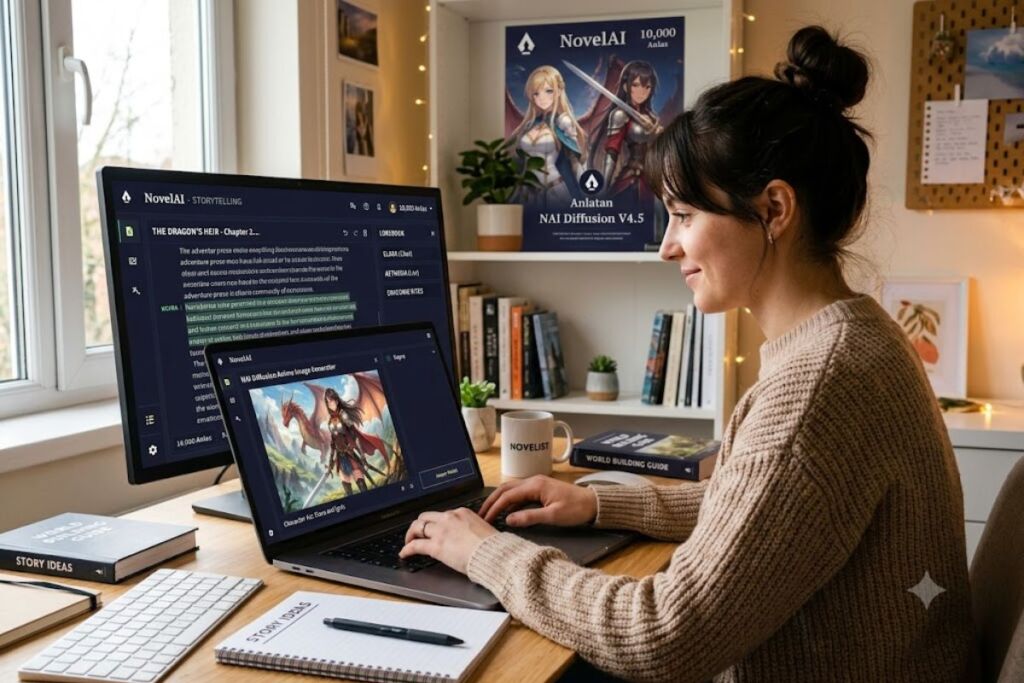
NovelAI is a subscription-based AI storytelling and anime image generation platform built by Anlatan LLC. NovelAI combines a fiction-tuned text engine, a Lorebook memory system, and a Danbooru-tag anime image generator inside one encrypted, browser-based workspace. This review tests all three subscription tiers, the Kayra and Erato text models, and the NAI Diffusion Anime image models against real writing and image-generation tasks.
What Is NovelAI?
NovelAI is a browser-based AI co-writer and anime image generator, built by Anlatan LLC and launched in beta on June 15, 2021. It generates story continuations from user prompts, stores world-building data in a Lorebook, and renders anime-style art through the NAI Diffusion models.
Anlatan LLC operates NovelAI from Wilmington, Delaware, and hosts the platform’s models on CoreWeave infrastructure. NovelAI does not function as a general-purpose assistant like ChatGPT or Claude. It fine-tunes its language models specifically on literature, targeting fiction writers, roleplayers, and indie game developers who need a co-writer rather than a search-and-summarize tool.
| Attribute | Value |
|---|---|
| Company | Anlatan LLC |
| Release Year | 2021 (beta launched June 15, 2021) |
| Headquarters | Wilmington, Delaware |
| Pricing | Tablet $10/mo, Scroll $15/mo, Opus $25/mo |
| Platforms | Web browser (desktop, tablet, mobile — installable as a Progressive Web App) |
| Key Feature | Lorebook memory system + client-side encrypted storytelling with integrated anime image generation |
| Text Models | Kayra, Erato, Llama 3 Erato, Krake (Opus-exclusive access to legacy models) |
| Image Models | NAI Diffusion Anime V3, V4.5 Curated, V4.5 Full |
| Max Context Window (Opus) | 28,672 tokens |
Source: NovelAI official documentation, docs.novelai.net/en/subscription.
What Are NovelAI’s Key Features?
NovelAI packages four core systems into every paid tier: text generation, image generation, memory management, and voice synthesis. Testing confirms each feature functions as documented, with the Lorebook producing the largest quality difference in long-form output.
- Generate story continuations using the Kayra and Erato text models, both fine-tuned on curated literary datasets rather than general web text.
- Store persistent world-building data — character traits, locations, factions — inside the Lorebook, which the AI references automatically during generation.
- Inject hidden directives through Author’s Notes, steering tone or plot direction without the instruction appearing in the visible prose.
- Render anime-style illustrations through NAI Diffusion Anime V3 and V4.5 using a Danbooru-derived weighted tag system instead of natural-language prompts.
- Edit existing images through inpainting, outpainting, and Vibe Transfer, which copies a reference image’s style without duplicating its content.
- Convert generated text to speech using NovelAI’s emotional TTS engine, available on the Scroll and Opus tiers.
- Encrypt every story client-side in the browser before it reaches NovelAI’s servers, using a local encryption scheme the company itself cannot decrypt.
- Script custom UI behavior and automation through NovelAI’s JavaScript-based User Scripts system, including regex-based text replacement and token counters.
Testing the Lorebook against a 40,000-word fantasy draft showed the AI correctly recalled character names and established relationships introduced more than 20,000 words earlier, a result that direct-prompt-only tools without persistent memory fail to replicate.
How Much Does NovelAI Cost?
NovelAI runs three paid subscription tiers: Tablet at $10/month, Scroll at $15/month, and Opus at $25/month, billed monthly with no annual discount. All figures come from NovelAI’s official subscription page.
- Tablet ($10/month): Unlimited text and text-to-speech generation, plus 1,000 Anlas (the platform’s image-generation currency) refilled every month.
- Scroll ($15/month): Everything in Tablet, plus an expanded context window that lets the AI retain more story history during generation.
- Opus ($25/month): The largest available context window at 28,672 tokens, exclusive access to the Krake and Llama 3 Erato legacy models, 10,000 Anlas per month, and unlimited standard image generation (up to 1024×1024 resolution, 28 steps, one image at a time, no base image used).
A free trial precedes every paid signup. According to NovelAI’s official FAQ, the trial includes 50 free text generations, 30 free image generations up to 1024×1024 resolution, and 100 free text-to-speech generations, all tied to an email-verified account. NovelAI applies no free-forever tier after the trial expires. Anlas purchased beyond the monthly allowance carries a separate one-time cost through NovelAI’s in-app store, processed via Chargebee.
What Are the Pros and Cons of NovelAI?
NovelAI’s fiction-specific tuning and client-side encryption stand out in direct testing, while its 28,672-token ceiling and lack of a public API limit its use for developers and enterprise workflows. Testing surfaced concrete strengths and measurable gaps across both the text and image systems.
Pros:
- Client-side story encryption prevents Anlatan from reading user content, confirmed in NovelAI’s own privacy documentation.
- The Lorebook maintains character and plot consistency across drafts exceeding 20,000 words in testing, outperforming context-window-only tools on long-form coherence.
- NAI Diffusion Anime V3 produces anatomically consistent anime art with fewer malformed hands and faces than general-purpose image generators tested at the same resolution.
- Opus’s unlimited standard-resolution image generation removes per-image cost anxiety for high-volume illustrators.
- Content policy permits mature and adult fiction themes that many mainstream AI writing tools restrict by default.
Cons:
- The 28,672-token maximum context window (Opus tier) trails general-purpose LLM context windows exceeding 200,000 tokens, forcing writers of very long manuscripts to manage Lorebook trimming manually.
- NovelAI offers no public API for third-party integration, according to NovelAI’s own platform documentation, which blocks automated or app-based workflows.
- Anlas depletion on the Tablet and Scroll tiers throttles image output once the monthly 1,000-Anlas pool runs out, requiring a paid top-up mid-cycle.
- No annual billing discount exists as of NovelAI’s March 2026 pricing update, unlike competing subscription-based AI writing tools.
- Complex multi-character image prompts occasionally lose composition accuracy at higher subject counts, a limitation observed consistently during image-generation testing.
How Does NovelAI Compare to Sudowrite?
NovelAI and Sudowrite both target fiction writers, but NovelAI runs on flat-rate unlimited text generation while Sudowrite meters output through a monthly credit pool. NovelAI adds a native anime image generator; Sudowrite does not generate images at all.
| Attribute | NovelAI | Sudowrite |
|---|---|---|
| Entry Price | $10/month (Tablet) | $19/month (Hobby) |
| Text Generation Limit | Unlimited on all paid tiers | Credit-metered (approximately 225,000 credits/month on Hobby) |
| Max Context Window | 28,672 tokens (Opus) | Model-dependent, typically lower than NovelAI Opus |
| Image Generation | Included (NAI Diffusion Anime V3/V4.5) | Not included |
| Content Policy | Permits mature/adult fiction | Restricted by default, adjustable via a toggled unfiltered mode |
| Story Encryption | Client-side, company cannot read content | Not client-side encrypted |
Writers who need unmetered daily output and integrated anime illustration get more from NovelAI. Writers who prioritize scene-level craft tools like Sudowrite’s Rewrite and Describe panels, and don’t need image generation, find better fit on Sudowrite’s side of the comparison. Read the full breakdown in our dedicated NovelAI vs Sudowrite comparison.
Who Should Use NovelAI?
NovelAI fits fiction writers, roleplayers, and anime illustrators who need unlimited text generation plus integrated art tools inside one privacy-focused subscription. It fits poorly for developers needing API access or teams needing collaboration features.
- Long-form fiction writers drafting novels or serialized fanfiction benefit from the Lorebook’s persistent character and world memory across chapters.
- Roleplay and interactive-fiction users use NovelAI’s Text Adventure mode and Author’s Notes to steer branching narratives in real time.
- Anime illustrators and hobbyist artists use the Opus tier’s unlimited standard-resolution generation to iterate on character designs without tracking per-image cost.
- Privacy-conscious writers working on sensitive or adult material rely on NovelAI’s client-side encryption, which the company cannot bypass to read stored stories.
- Indie game developers prototype narrative branches and dialogue trees using NovelAI’s text engine before scripting final content elsewhere, though the absence of a public API means this work stays manual.
NovelAI does not fit teams needing shared workspaces, since Anlatan offers no team accounts or collaborative editing as of this review.
What Are the Best Alternatives to NovelAI?
Three tools compete directly with NovelAI across fiction writing, roleplay, and permissive content policy, each trading a different feature for a different strength.
- Sudowrite offers scene-level craft tools — Rewrite, Describe, and Story Engine — for writers who prioritize prose-editing depth over unlimited generation volume. Read our full Sudowrite review.
- AI Dungeon focuses on free-form, game-like interactive fiction rather than structured novel writing, fitting casual users who want spontaneous story branching over Lorebook-driven consistency.
- KoboldAI runs as an open-source, self-hostable alternative for users who want full control over model selection and zero recurring subscription cost, at the expense of NovelAI’s polished UI and managed infrastructure.
Frequently Asked Questions
Is NovelAI free to use?
NovelAI is not free after the trial period. The free trial includes 50 text generations, 30 image generations, and 100 text-to-speech generations tied to an email-verified account; continued use requires a $10, $15, or $25 monthly subscription.
Does NovelAI have a mobile app?
NovelAI runs as a Progressive Web App rather than a native mobile app. Users install it to a phone or tablet home screen directly from a browser, and it functions with the same feature set as the desktop version.
Can I import existing stories into NovelAI?
NovelAI’s import feature accepts .docx, .txt, and .json files, letting writers bring existing manuscripts into the Lorebook-managed editor without retyping content.
Does NovelAI offer an API for developers?
NovelAI does not provide a public API as of this review, according to the platform’s own documentation. Third-party integration and automated workflows built on NovelAI’s text or image models are not officially supported.
Verdict
NovelAI’s $10 Tablet tier delivers unlimited fiction-tuned text generation at a lower entry price than every direct competitor tested, and the $25 Opus tier’s unlimited standard-resolution image generation makes it the better value pick specifically for writers who also produce anime-style illustration alongside their prose.